
Start your project with reliable, scan-accurate documentation you can trust.






How High-Definition Laser Surveying Works
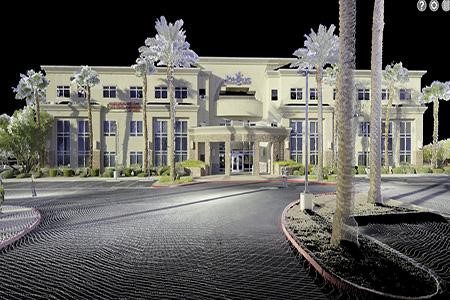
High-definition surveying uses terrestrial laser scanners to emit rapid pulses of light that measure distance based on return time. These measurements form a dense “point cloud” — a three-dimensional dataset representing walls, floors, ceilings, structural elements, and mechanical systems.
The process typically includes:
- Field capture from multiple scan positions
- Targeting or control alignment
- Registration into a unified dataset
- Quality verification checks
The result is a measurable digital environment that reflects actual field conditions.
High-Definition Surveying vs. Traditional Survey Methods
Traditional methods:
- Manual measurements
- Limited sampling
- Potential human error
- Time-intensive verification
High-definition laser surveying:
- Millions of measured points
- Reduced need for return site visits
- Visual reference through panoramic imagery
- Improved coordination across trades
This does not replace all traditional surveying tools — but it significantly improves documentation density and verification capability.
Accuracy in High-Definition Laser Surveying
Accuracy depends on:
- Equipment specifications
- Distance and line of sight
- Surface reflectivity
- Registration method
- Control strategy
When properly planned, terrestrial laser scanning can support renovation and coordination workflows that demand consistent spatial verification.
Common Applications of High-Definition Laser Surveying
High-definition surveying is commonly used for:
- Renovation planning
- Congested MEP environments
- Retrofit upgrades
- Historical documentation
- Construction verification
- Coordination workflows
For teams who need dependable field data for design or construction use, working with a professional 3D laser scanning provider is the most reliable path to complete, verified existing-conditions documentation.
Why Terminology Matters
“High-definition surveying” and “3D laser scanning” are often used interchangeably in the AEC industry. The terminology may vary by region, discipline, or project requirements, but the underlying principle remains the same: capturing existing conditions using LiDAR-based reality capture technology.
Frequently Asked Questions
A: LiDAR is the broader technology that measures distance using light pulses. Terrestrial laser scanning is one application of LiDAR used in building documentation and construction environments.
A: In most building documentation contexts, yes — the terms describe similar reality-capture methods.
A: Accuracy depends on equipment, setup, distance, control strategy, and environmental factors.
A: It is most beneficial when renovation accuracy, coordination reliability, or verification matters more than approximate measurements.
A: High-definition laser surveying and traditional land surveying serve different purposes. Traditional surveying establishes legal boundaries and site elevations. High-definition laser surveying documents interior and exterior building conditions — walls, structure, MEP systems — for design and construction use. Most renovation and coordination projects need the latter.
A: High-definition laser surveying uses terrestrial laser scanners, sometimes called phase-based or time-of-flight scanners. These devices emit light pulses to measure distances and generate dense 3D point clouds.
Equipment selection depends on:
• Required accuracy
• Scan range
• Site conditions
• Line-of-sight constraints
• Environmental factors
Scanner specifications influence data density, capture speed, and downstream usabilit
For project-specific scanning requirements, review our 3D Laser Scanning Services page.