
Start your project with reliable, scan-accurate documentation you can trust.




STATS
Years in As-Built Documentation
U.S. Markets Served
±2mm
Verified Dimensional Accuracy
Buildings Documented
What Is Scan to BIM Modeling?
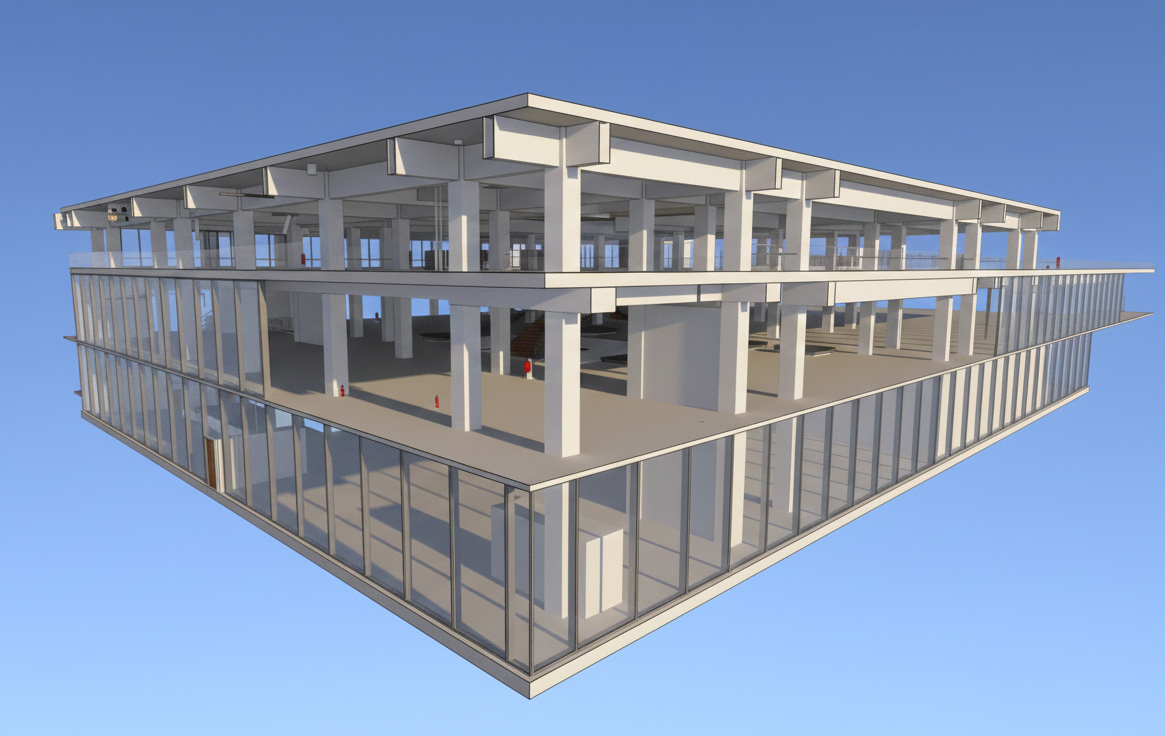
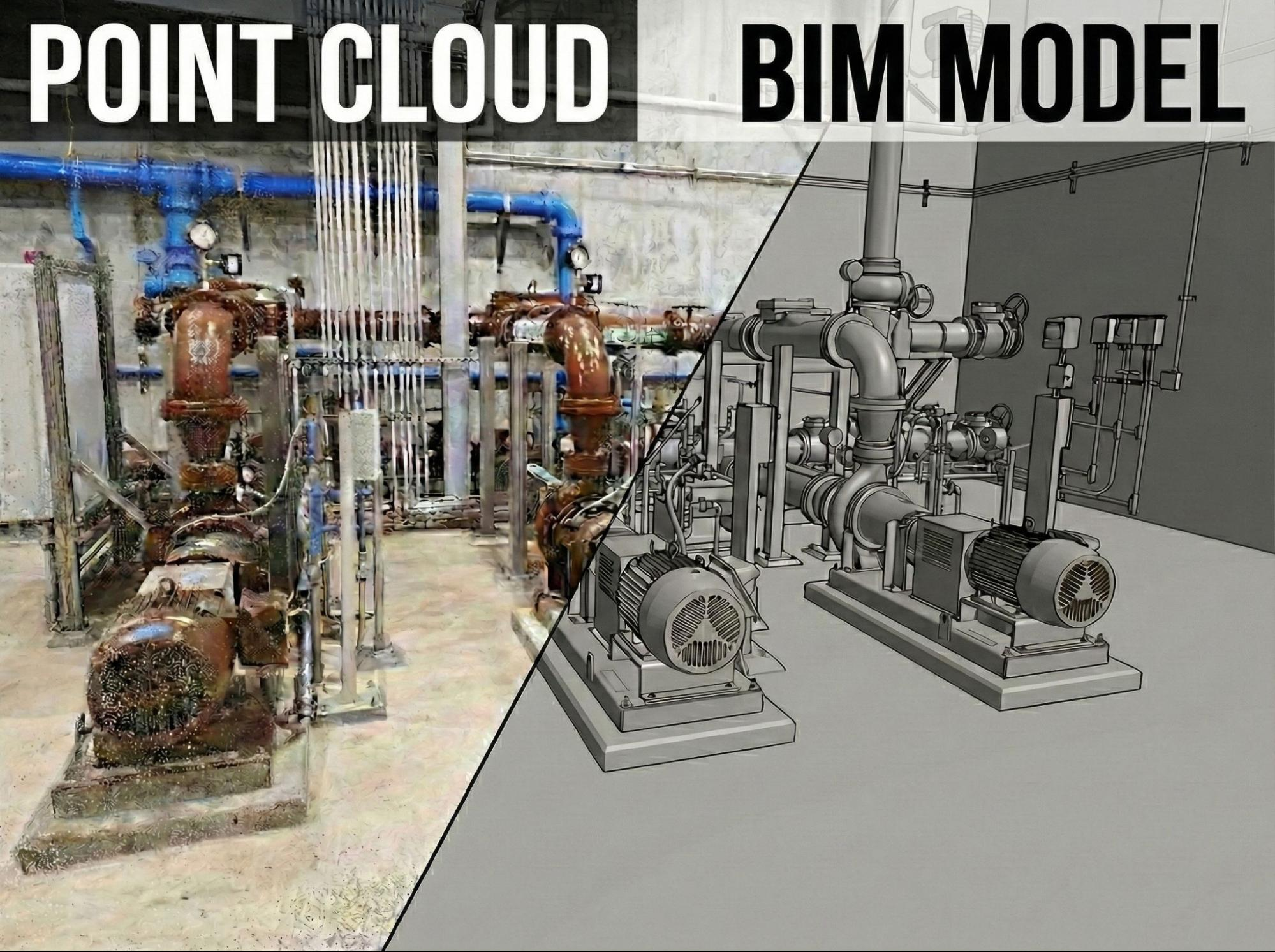
Scan to BIM modeling is the process of converting registered point cloud data — captured by a 3D laser scanner — into an intelligent Revit model inside Autodesk Revit or a compatible BIM platform. The resulting as-built Revit model replaces traditional field measurements with millimeter-level accuracy, capturing walls, structural systems, MEP routing, and building geometry exactly as they exist today.
For renovation, retrofit, tenant improvement, and facility management projects, a verified as-built BIM model eliminates the costly errors that occur when teams work from outdated drawings or manual measurements. Point cloud integration in Revit allows your design team to overlay new work directly on confirmed existing conditions, reducing RFIs and BIM coordination conflicts before construction starts.
Whether your project requires LOD 200 massing documentation, LOD 300 construction-ready Revit geometry, or LOD 400 fabrication-level MEP BIM detail, a verified existing conditions Revit model gives every stakeholder an accurate digital baseline to design from. For teams that need 2D CAD drawings alongside BIM deliverables, we provide complete scan to CAD documentation as well.
How We Work: The Four-Step Process
Step 1 — Site Scanning
Our certified operators deploy Leica RTC360 or Faro Focus scanners at your facility. Scan positions are planned for full coverage with sufficient overlap — no data gaps, no loose registration passed back to your team to resolve. For occupied buildings we coordinate off-hours access and minimize operational disruption. For multi-location programs we deploy standardized capture protocols so every facility in your portfolio is documented to the same standard, whether we’re on location three or location thirty-three.
Step 2 — Point Cloud Registration
All scans are registered to a verified control network and unified into a single, accurate point cloud dataset ready for point cloud integration in Revit. This is where most providers cut corners — loose registration is the most common source of error in an as-built BIM model, and it compounds through every downstream step. We don’t skip control verification.
Step 3 — Revit Modeling from Point Cloud
Our domestic production team builds your as-built Revit model directly from the registered point cloud. Architectural BIM model elements, structural BIM model components, and MEP BIM model systems are modeled to your specified LOD — 200, 300, or 400 — scoped by system. We work to current Autodesk Revit standards with your naming conventions and BIM execution plan where provided. If geometry is obscured in the scan data we document that explicitly rather than filling gaps with assumptions.
Step 4 — QA/QC & Delivery
Before any file leaves our hands the completed as-built Revit model is systematically compared against source point cloud data at specified tolerances. We check dimensional accuracy, LOD compliance, and BIM coordination between building systems.
LOD Standards: Quick Reference
| LOD Level | What Is Modeled | Best For | Typical Project Type |
|---|---|---|---|
| LOD 200 | Approximate geometry — size, shape, location | Massing studies, space planning, early BIM coordination | Feasibility, pre-design |
| LOD 300 | Exact dimensions, precise location, construction-ready Revit geometry | Construction documents, permit submissions, renovation coordination | Tenant improvement, retail, office |
| LOD 400 | Fabrication-level detail, connections, installation data in Revit | MEP fabrication, facility management, complex BIM coordination | Healthcare, data centers, MEP retrofit |
Scan to BIM Modeling Services
Full-Service Scan to BIM Modeling
End-to-end: we handle site scanning, point cloud registration, Revit modeling from point cloud, and model QA/QC. One engagement, one accountable team, one set of BIM deliverables. Best for architects and owners who need a verified as-built Revit model without managing multiple vendors or validating someone else’s scan quality.
- Deliverables: Registered point cloud (.E57, .RCP/.RCS), as-built Revit model (.rvt) to specified LOD, architectural BIM model elements, structural and MEP BIM model systems, 2D CAD drawings (.dwg), QA/QC report.
Revit Modeling from Existing Point Cloud
Already have scan data? Our Revit modeling from point cloud service converts your registered scan files into a fully coordinated as-built BIM model. Useful for surveying firms and AEC companies that capture their own data but need specialist BIM modeling services and domestic production bandwidth.
- Accepted formats: .E57, .RCP, .RCS, .LAS from any professional-grade scanner.
- Deliverables: LOD 200–400 architectural BIM model, structural BIM model, MEP BIM model, custom Revit families, standards-compliant BIM deliverables.
3D Laser Scanning — Capture Only
Field capture for design teams with internal Revit production. We deploy Leica RTC360 and Faro Focus equipment with experienced operators across all seven Southwest markets and deliver fully registered, high-density point cloud data ready for point cloud integration in Revit. No gaps, no cleanup work passed back to you.
- Deliverables: Registered point cloud, 360° HDR imagery, site control report, accuracy verification.
Multi-Location BIM Programs
Standardized scan to BIM modeling workflows for retail chains, hotel portfolios, and commercial real estate at scale. Our model setup and standards framework ensures consistent naming conventions, Revit family standards, and LOD compliance across every location — enabling true portfolio-wide BIM coordination whether you’re documenting five properties or fifty.
- Deliverables: Standardized Revit templates, portfolio-wide BIM deliverables, centralized data management, volume pricing.
Expedited BIM Delivery
Fast-track scan to BIM modeling for projects where standard turnaround doesn’t work. Our 48-hour rush service maintains the same model accuracy and tolerances as our standard workflow, with dedicated project coordination and real-time progress updates throughout delivery.
Independent BIM Model Auditing
Third-party model QA/QC services verifying that existing Revit models match field conditions and comply with project LOD standards. We perform independent accuracy audits, clash coordination support reviews, and model setup and standards compliance checks on as-built BIM models produced by any provider. Useful when you’ve inherited Revit documentation of unknown quality.
Why the Process Matters More Than the Equipment
The firms competing on this search use the same scanners we use. Leica and Faro equipment is widely available. The differentiator isn’t hardware — it’s what happens after the scan.
- We register to a verified control network — Not just scan-to-scan. A verified ground control network is what ensures your as-built Revit model is accurate in real-world coordinates, not just internally consistent.
- We model from point cloud data, not assumptions — If geometry is obscured we document it explicitly. What you don’t know about a building is as important as what you do — we won’t fill gaps with guesses that become RFIs in the field.
- We verify every as-built BIM model before delivery — Model QA/QC is a systematic dimensional comparison against source point cloud data, not a visual review. You receive a report documenting what was checked and what tolerances were met.
- 27 years of commercial architecture experience — We’ve been on the other side of this deliverable. We know what a bad as-built Revit model costs a project, and we build ours accordingly.
Industries We Serve
Retail & Restaurant
We’ve provided as-built Revit models for Nike, Apple, REI, Urban Outfitters, and Coca-Cola — brands that operate at volume, maintain strict design standards, and cannot afford BIM documentation errors in tenant improvement or renovation work. Retail scan to BIM modeling typically delivers LOD 300 architectural and structural Revit models with accurate storefront geometry, ceiling heights, and utility rough-in locations. For national rollout programs we deploy standardized scan to BIM workflows so Revit documentation is consistent whether you’re on store three or store thirty-three.
Hospitality & Hotels
Hotel renovation projects present specific BIM documentation challenges: occupied facilities, complex MEP systems, and renovation scopes requiring precise BIM coordination between existing conditions and new design. We’ve worked extensively with hospitality clients on full-floor and full-property Revit modeling, delivering LOD 300–400 as-built BIM models that capture existing plumbing, HVAC routing, and structural elements in the detail MEP engineers and contractors need. Off-hours scanning capability across all seven Southwest markets means your operations don’t stop for documentation.
Healthcare
Healthcare renovation and retrofit projects carry the highest BIM documentation stakes of any commercial sector. Infection control requirements, occupied facility constraints, and the precision demands of medical equipment coordination mean that inaccuracies in an as-built BIM model have direct operational consequences. We deliver LOD 400 MEP BIM models that support infection control zone modeling, equipment clearance verification, and BIM coordination between existing structural systems and new MEP Revit model routing. Our process explicitly flags any obscured geometry rather than estimating — in healthcare, assumptions are not acceptable.
Commercial Office
Tenant improvement and core-and-shell Revit documentation for commercial office projects. LOD 300 architectural and MEP BIM models for renovation coordination, lease space documentation, and base building verification. We work with building owners, property managers, and design teams on both single-floor TI projects and full-building scan to BIM programs.
Historic Preservation
Existing conditions Revit models for historic structures require a higher level of care than standard commercial scan to BIM work — irregular geometry, non-standard materials, and the need to capture detail that doesn’t exist in original drawings. Our Leica RTC360 platform captures sub-millimeter surface detail that preservation architects need, and our Revit modeling team translates that complexity into as-built BIM models that support preservation review submissions and adaptive reuse design.
Data Centers & Industrial
Mission-critical facilities require LOD 400 MEP BIM model documentation — power distribution, cooling infrastructure, structured cabling pathways. We work with facility managers and design engineers on both initial Revit modeling and ongoing change management, producing as-built BIM models that support capacity planning, equipment replacement, and future expansion BIM coordination.
Southwest Coverage
Las Vegas · Phoenix · Los Angeles · San Francisco · Denver · Salt Lake City · Austin
Regional coverage across all seven markets for rapid field deployment. Nationwide scan to BIM modeling coordination available for multi-location programs.
Frequently Asked Questions
A: Field laser scanning or point cloud intake, registration to a verified control network, Revit modeling from point cloud to your specified LOD by building system, systematic model QA/QC against source scan data, and RVT file delivery with supporting documentation. Full-service engagements also include 360° HDR imagery, 2D CAD drawings (.dwg), and a compliance report.
A: Retail and restaurant locations in the 3,000–8,000 SF range typically run $2,900–$4,500 for scanning and Revit modeling combined. Larger commercial buildings are quoted per square foot based on complexity and LOD scope. Multi-location programs carry volume pricing. Contact us for a detailed scan to BIM pricing proposal specific to your project.
A: LOD specification is the primary driver of Revit modeling cost beyond square footage. LOD 400 MEP BIM model production requires modeling every conduit run, pipe segment, and equipment connection — significantly more production time than LOD 200. We scope LOD by building system so you pay for detail only where your project actually requires it, not as a blanket specification across the entire as-built Revit model.
A: Accuracy depends on the level of detail and verification required for the project.
- Standard BIM models are typically produced to ±1/2" accuracy, suitable for design, planning, and general coordination.
- Field-verified models are available at ±1/8" (≈3–5 mm) for projects requiring higher precision, such as detailed coordination or construction documentation.
Our LiDAR scanners (Leica RTC360 and FARO Focus) capture millimeter-level data in the field. Final model accuracy is achieved through controlled registration, modeling, and QA/QC—validated by comparing the completed Revit model against the source point cloud before delivery.
This approach supports LOD 300 and LOD 400 requirements where higher accuracy is specified.
A: We work to current Autodesk Revit standards using manufacturer-specific families for MEP equipment and generic parametric families for architectural and structural BIM model elements. Where clients provide a BIM execution plan, Revit family library, or naming conventions, we work within those standards. If none are specified we apply AIA CAD Layer Guidelines and current BIM best practices, documented in the QA/QC report.
A: LOD 200 Revit models define building elements with approximate size, shape, and location — sufficient for massing studies, early BIM coordination, and space planning. LOD 300 delivers exact, construction-document-ready geometry with precise dimensions suitable for permit submissions and renovation coordination. LOD 400 adds fabrication-level MEP BIM model detail for healthcare, data center, and complex MEP retrofit projects. We recommend scope in consultation based on your project’s actual downstream use.
A: Standard turnaround is 5-10 days for commercial Revit modeling most mid-sized commercial projects, depending on scope and LOD from point cloud delivery. Complex projects with full MEP BIM model requirements or LOD 400 scope are quoted with phased delivery schedules. Expedited 48-hour RVT file delivery available for time-critical projects at a rush premium.
A: Yes — native Revit (.rvt) files with every scan to BIM engagement. We also deliver registered point clouds (.rcp/.rcs), 2D CAD drawings (.dwg), and PDF documentation as standard. IFC files, Navisworks models (.nwc/.nwd), and COBie data available on request.
A: Yes. We export IFC 2x3 and IFC 4 files from the completed as-built Revit model, configured for ArchiCAD, Vectorworks, Bentley, and other BIM platforms. IFC export settings are matched to your software and workflow requirements. Navisworks .nwc/.nwd for coordination review workflows and COBie data for facility management applications also available.
A: Yes. Our Revit modeling from point cloud service accepts data from any professional-grade scanner in .E57, .RCP, .RCS, or .LAS format. Send us a sample file and we’ll assess registration quality and coverage, then scope the scan to BIM modeling engagement accordingly. If the source data has registration issues that would affect as-built Revit model accuracy, we’ll tell you before starting.
A: Scan to CAD produces 2D AutoCAD drawings — floor plans, elevations, and sections in DWG format. Scan to BIM modeling produces an intelligent 3D as-built Revit model where building elements carry data, not just geometry, supporting clash detection, MEP BIM coordination, quantity takeoffs, and facility management. For projects requiring construction documentation and BIM coordination, Revit modeling is the appropriate deliverable. For projects requiring only measured 2D drawings, scan to CAD may be sufficient. We offer both services and can advise on the right approach.
Ready to Talk Through Your Project?
We work best with clients who have a specific project in front of them and want to know exactly what scan to BIM modeling they need and what it will cost.
Call: 888-543-2711
Email:info@lidarpreciseplans.com
Serving Las Vegas, Phoenix, Los Angeles, San Francisco, Denver, Salt Lake City, Austin, and nationwide