How Scan to BIM Services Eliminate Change Orders on Commercial Renovation Projects

You pull the existing drawings from the permit set. They’re dated 2006. Two tenant improvements have happened since: the HVAC was rerouted sometime around 2014, and the ceiling plenum above the proposed breakroom has zero documentation. You send a field team to measure. They come back with hand dimensions that tell you where the walls are today, but nothing about what’s running three feet overhead. Now you’re pricing a commercial renovation with an above-ceiling coordination problem that won’t reveal itself until the MEP contractor shows up with equipment that doesn’t fit. That gap is exactly where change orders are born.
Quick Answer: Scan to BIM services eliminate change orders on commercial renovation projects by replacing assumption-based documentation with verified existing conditions captured before design begins. LiDAR 3D laser scanning at plus or minus 2mm accuracy captures every wall, structural element, and above-ceiling MEP system in the building. That data converts into a Revit as-built model at LOD 300 or LOD 350, giving design and construction teams a three-dimensional baseline they can coordinate against with precision. Field conflicts surface during design, where resolving them costs nothing, rather than during construction, where they generate costly change orders. Turnaround: 5 to 14 business days. Quotes in 24 hours.
Why Commercial Renovation Projects Are Change Order Factories
New construction operates from a defined design intent. Renovation projects operate from a collision between design intent and physical reality. That collision, when undocumented, produces the conditions that generate change orders: discovered MEP conflicts, unverifiable dimensions, missing as-built documentation, and structural conditions nobody anticipated.
According to a joint study by Autodesk and FMI, 52% of rework in construction is caused by poor project data and miscommunication, and that figure climbs sharply on renovation projects where original drawings are the primary reference. Roughly 4 to 6% of the total project cost is the median cost of rework when only direct costs are counted; when indirect factors are included, the actual total cost of rework reaches 9% of the total project cost. On a $2 million commercial renovation, that’s $120,000 to $180,000 in exposure, most of it traceable to documentation gaps that existed before the first permit drawing was submitted.
The documentation gap follows a predictable pattern. Original construction drawings capture the building as it was designed. They rarely capture the building as it was built. Decades of tenant improvements, MEP modifications, and code upgrades accumulate without systematic documentation. By the time a general contractor takes on a renovation, the existing drawings describe a building that no longer precisely exists. Scan to BIM services exist specifically to close that gap.
What Scan to BIM Services Capture That Hand Measurement Cannot?
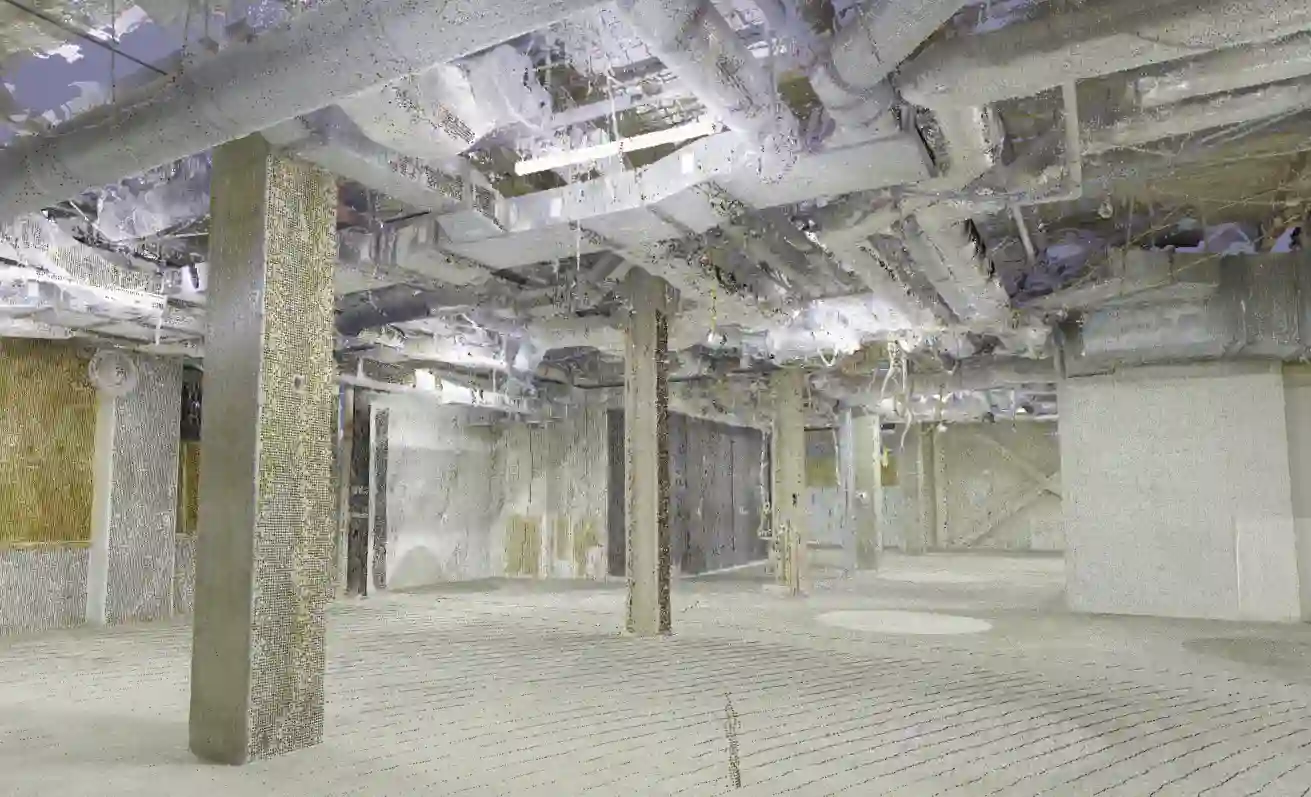
LiDAR-based scan to BIM services resolve the documentation gap by capturing the complete physical reality of a building at densities and accuracies impossible through manual measurement. LiDAR technology records millions of points per second, producing a registered point cloud that represents every visible surface in three dimensions at tolerances of plus or minus 2mm (plus or minus 1/8 inch). Three categories of data separate LiDAR-driven BIM workflows from traditional field measurement on renovation projects:
Above-Ceiling MEP Conditions
Existing HVAC ductwork, plumbing risers, electrical conduit, fire suppression mains, and data infrastructure occupy the same ceiling plenum where new MEP systems must route. In renovations with tight ceiling heights, available clearance can measure as little as 12 to 18 inches. Without documented as-built MEP routing, new system design proceeds on assumptions. Those assumptions produce RFIs the moment installation begins.
Scan to BIM services capture plenum conditions systematically. Duct routing, dimensions, and clearances are modeled in Revit at sufficient detail for clash detection before a single piece of equipment is ordered. That single capability, fully above-ceiling MEP documentation converted to a coordinated Revit model, is where the majority of renovation change order exposure is eliminated.
Structural Geometry and Field Deviation
Renovation projects frequently require penetrations, connections, and structural modifications. Column locations, beam depths, and slab thicknesses derived from original drawings must be verified against actual field conditions before structural engineering proceeds. Point cloud data captures real structural geometry, including deviations from original design, settlement, and undocumented modifications.
Architectural Conditions That Drive MEP Routing
Irregular wall planes, sloped floors, and varying ceiling heights all affect MEP routing paths. A wall that bows 1.25 inches over its height changes the clearance calculation for ductwork running parallel to it. Scan to BIM services capture these variations; hand measurement typically does not.
LOD Selection for Commercial Renovation: Matching Detail to Coordination Needs
Level of Development (LOD) selection for renovation Scan-to-BIM follows a different logic than new construction. The question is not how much detail the new work requires; it’s how much existing conditions detail the design and construction team needs to coordinate against without generating field conflicts.
| Project Type | Recommended LOD | Primary Use | MEP Detail Level |
| Standard commercial renovation | LOD 300 | Design development, permit docs | Routing and system types |
| MEP-heavy retrofit/hospital | LOD 350 | Clash detection, full coordination | Ductwork dimensions, pipe diameters, conduit |
| Historic preservation | LOD 300–350 | Architectural detail, permit compliance | Structural and finish elements |
| Adaptive reuse/tenant improvement | LOD 300 | Space planning, code analysis | Utility stub locations |
LOD 300 deliverables model walls, structural members, and MEP systems at actual size and location with sufficient accuracy for design development and permit documentation. This level supports space planning, code compliance analysis, and construction document production for the majority of commercial renovation scopes. Most laser scanning to BIM workflows for standard commercial renovation deliver at LOD 300 by default.
LOD 350 adds the interface and connection detail required for full MEP coordination. Ductwork is modeled with actual dimensions and fittings; pipes carry accurate diameters and routing; electrical conduit is captured with sizing and path. For MEP-heavy retrofits where new and existing systems must share a ceiling plenum, LOD 350 is the specification that enables clash detection to function as intended. For further details on LOD specifications, see our LOD explanation guide.
The decision rule: if your renovation involves significant MEP work in an occupied ceiling space, specify LOD 350 scan to BIM services. If it’s primarily architectural, LOD 300 gives your design team what it needs.
The Scan-to-BIM Workflow on a Commercial Renovation Project
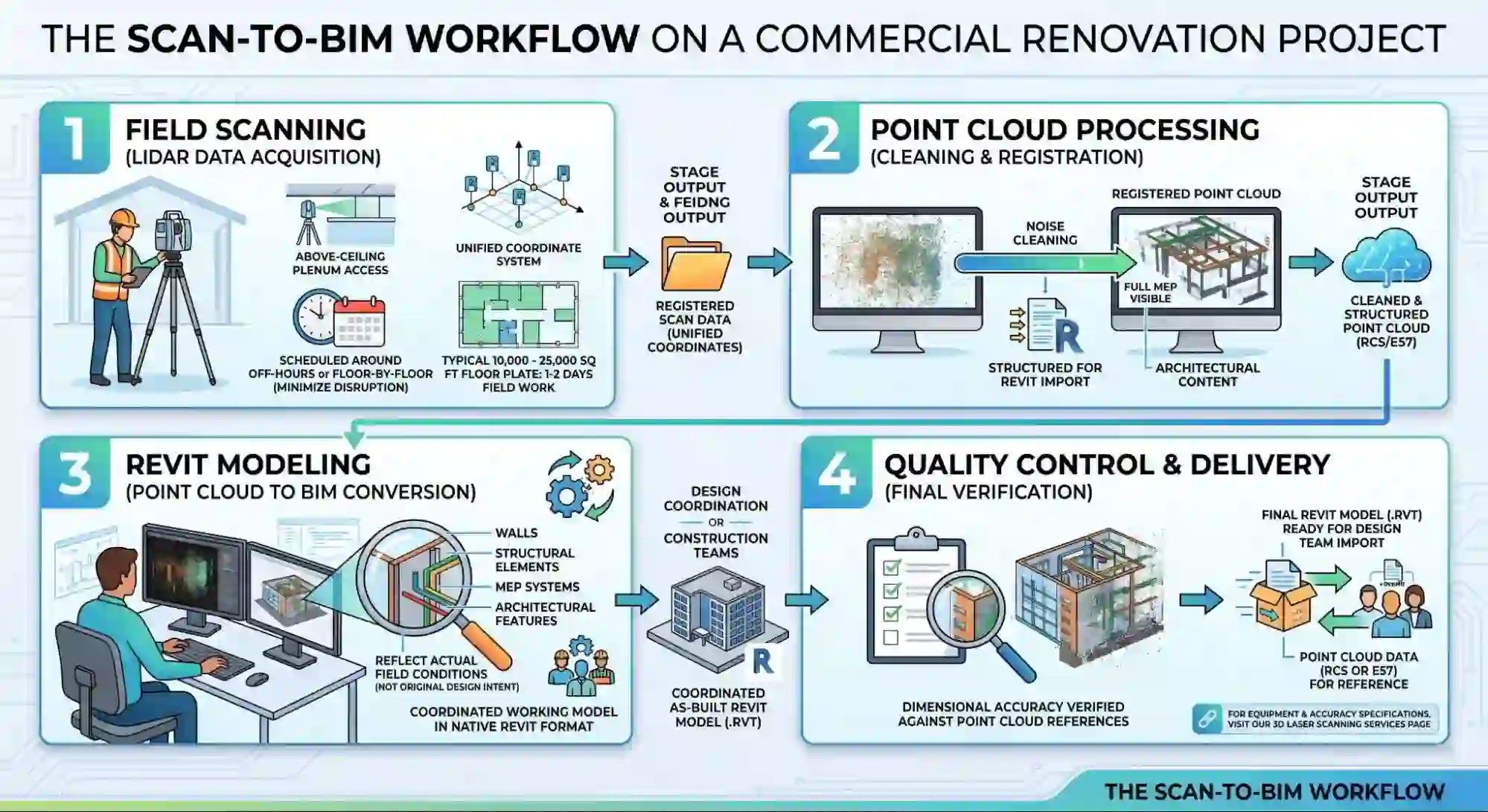
Scan to BIM services run in four stages. Each stage has a defined output that feeds the next phase of design or construction coordination.
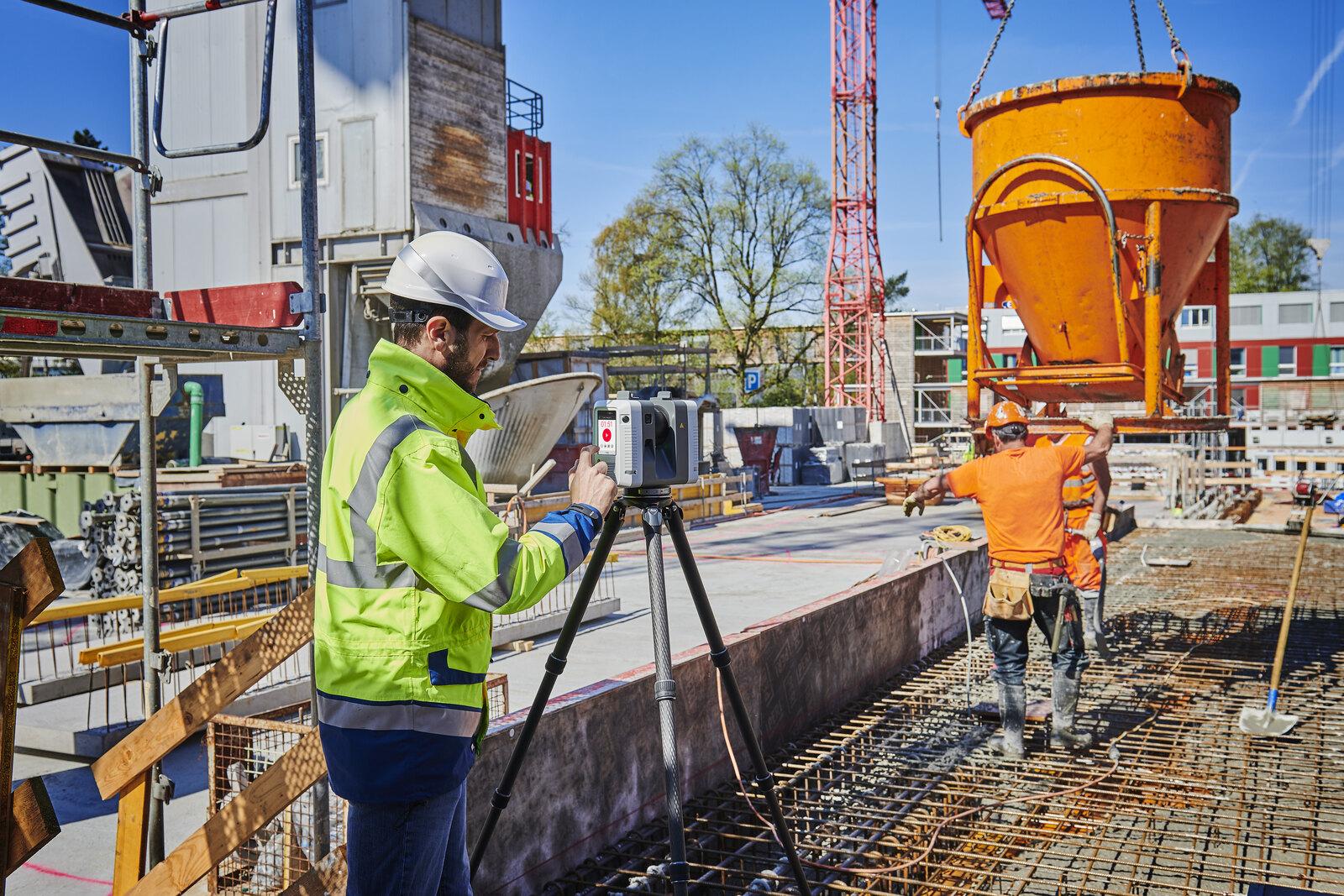
Field Scanning: LiDAR scanners are deployed throughout the building, including above-ceiling access points in plenums. Scan positions register to a unified coordinate system. For occupied buildings, scanning schedules around off-hours or proceeding floor-by-floor to minimize operational disruption. A typical commercial renovation floor plate of 10,000 to 25,000 square feet requires one to two days of field work.
Point Cloud Processing: Raw scan data is processed into a registered point cloud, cleaned of noise, and structured for Revit import. The point cloud at this stage represents the building as it exists, with full MEP and architectural content visible and measurable.
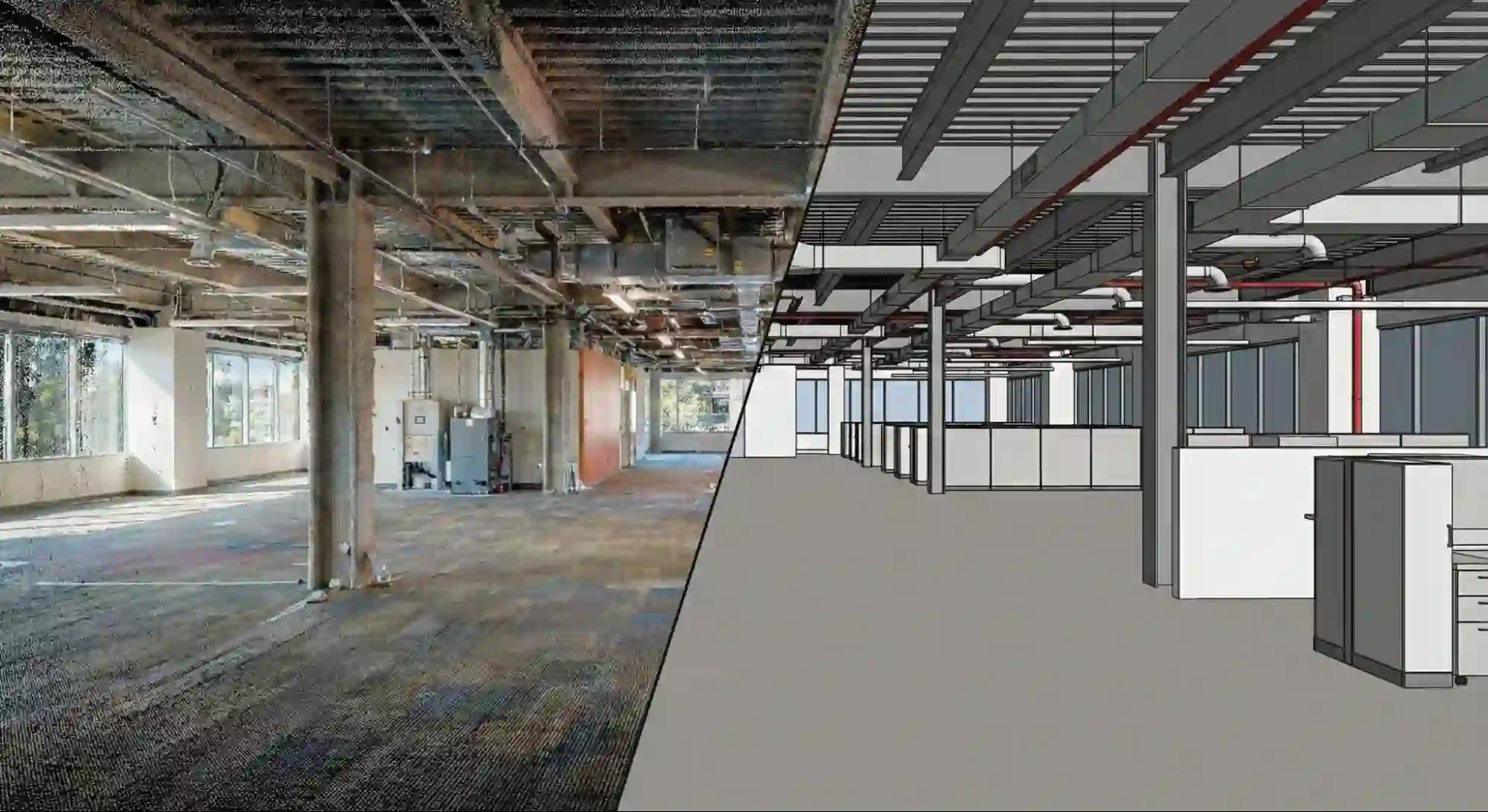
Revit Modeling: BIM technicians model existing conditions from the point cloud at the specified LOD. Walls, structural elements, MEP systems, and architectural features reflect actual field conditions, not original design intent. This is the deliverable that makes scan-to-BIM services operationally useful for design coordination: not just data, but a coordinated Revit as-built model in a format the design team can work in directly. This point cloud to BIM conversion stage is where field reality becomes a coordinated working model for design and construction teams.
Quality Control and Delivery: Dimensional accuracy verifies against point cloud references. The final Revit model delivers in .rvt format, ready for import into the design team’s active project file. Point cloud data is delivered in RCS or E57 format for reference. See our full 3D laser scanning services page for equipment and accuracy specifications.
The Cost and Risk Reality of Skipping LiDAR-Based Building Documentation
Every commercial renovation carries a documentation decision point: invest in verified existing conditions before design, or proceed from original drawings and field measurements and absorb the exposure when construction begins.
| Condition | With Scan to BIM Services | Without Scan to BIM Services |
| MEP conflicts discovered | Before design (design phase) | During construction (change order) |
| Documentation accuracy | Plus or minus 2mm verified | Assumed from drawings |
| Above-ceiling coordination | Full clash detection in Revit | 2D overlay, conflict-prone |
| Permit submittal confidence | Field-verified dimensions | Estimated or unverified |
| Schedule risk | Identified early, manageable | Discovered mid-construction |
| Rework exposure | Minimized pre-construction | Up to 9% of total project cost* |
The fee for LiDAR-to-BIM modeling services on a 20,000-square-foot commercial renovation typically runs $4,000 to $12,000, depending on LOD and MEP complexity. A single change order generated by an above-ceiling MEP conflict typically runs $8,000 to $35,000, depending on scope, trade involvement, and schedule impact. If that conflict requires the redesign of already-fabricated ductwork, the cost increases further. If it delays a critical-path activity, the schedule impact multiplies the direct cost.
The calculation is direct: scan to BIM services carries a known, fixed pre-construction cost. Undocumented existing conditions carry a variable, unpredictable cost that consistently runs higher. Dodge Data and Analytics reports that 61% of firms using BIM processes saw reduced project error, and 55% reported that BIM processes reduced the time required for communications. Both outcomes trace directly to having accurate as-built documentation before design coordination begins.
For a deeper look at what documentation errors actually cost by phase, see 5 Mistakes in As-Built Plans.
How LiDAR Precise Plans Delivers Scan to BIM Services for Renovation Projects
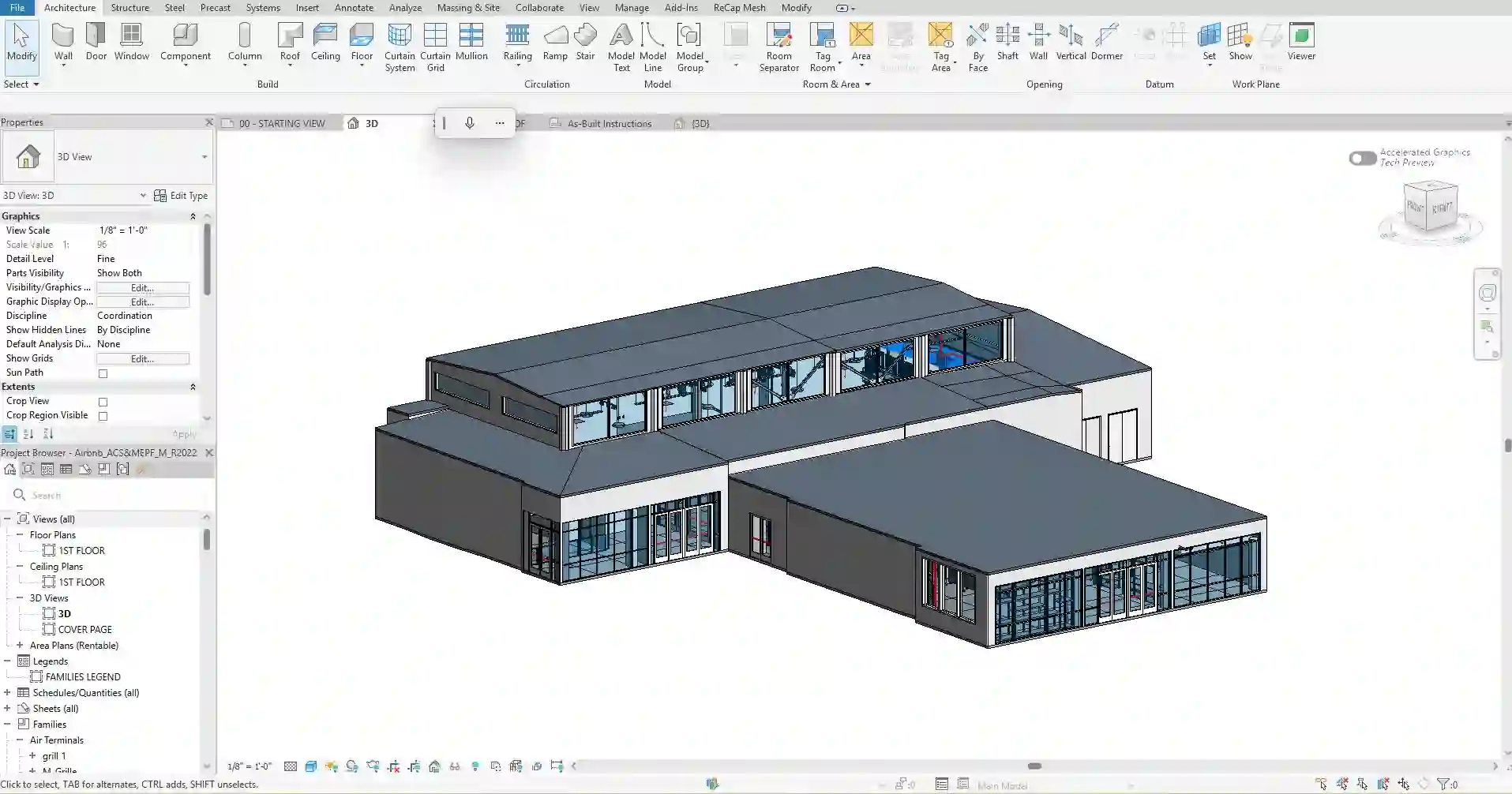
LiDAR Precise Plans has documented more than 4,200 buildings across commercial, hospitality, industrial, and historic preservation sectors. Our LiDAR-to-BIM workflows for renovation projects deliver verified dimensional accuracy within plus or minus 2mm, using registered laser scans tied to a unified coordinate system across floors, ceiling plenums, and structural access points.
For most renovation scopes, we deliver LOD 300 Revit as-built models within 5 to 14 business days after field scanning is completed. Projects requiring MEP coordination and clash detection are scoped at LOD 350 based on ceiling congestion, routing complexity, and existing conditions. We support projects across Las Vegas, Phoenix, Scottsdale, Los Angeles, San Francisco, Denver, Salt Lake City, and Austin, with turnaround quotes typically returned within 24 hours.
Our reality capture and BIM modeling services provide Revit .rvt deliverables ready for direct integration into active project environments. Registered point cloud files are delivered in RCS and E57 formats compatible with major BIM platforms and coordination workflows. When projects require both 3D models and 2D documentation, we also produce coordinated Scan-to-CAD drawings in AutoCAD .dwg format. For renovation projects involving dense mechanical infrastructure, our MEP documentation services provide additional system-level detail for design coordination and construction planning.
If your renovation includes above-ceiling MEP work, phased occupancy constraints, permit submissions requiring verified existing conditions, or a design schedule with limited tolerance for field conflicts, engaging existing conditions BIM modeling services before design development begins significantly reduces downstream coordination risk.
LiDAR Turns Renovation Risk Into a Manageable Pre-Construction Variable
Change orders on commercial renovation projects are not inevitable. They are predictable when existing conditions are undocumented, and they are preventable when scan to BIM services feed a coordinated Revit model into the design process before construction documents are issued. The projects that generate the most change orders are the ones that moved to design documents before anyone confirmed what was actually running in the ceiling plenum.
Ready to eliminate change order exposure on your next renovation project?
Request your scan for the BIM services quote or call 888-543-2711. Quotes returned within 24 hours.
Frequently Asked Questions (FAQ)